Turkey SVG File: Graphics for Crafts & Local Branding
As a brand designer who’s helped over 80 local businesses refine their visual identity—from artisanal soap studios in Portland to family-run bakeries in Nashville—I recently evaluated the Turkey SVG File for a real-world seasonal branding project: a limited-edition Thanksgiving line for “Hearth & Grain,” a small-batch oat milk coffee roastery and bakery. My goal wasn’t just to drop in clipart—it was to assess whether this graphic design asset could meaningfully strengthen their brand identity, packaging design, and customer-facing marketing visuals.
First Impression: Warm, Handmade, Seasonally Grounded
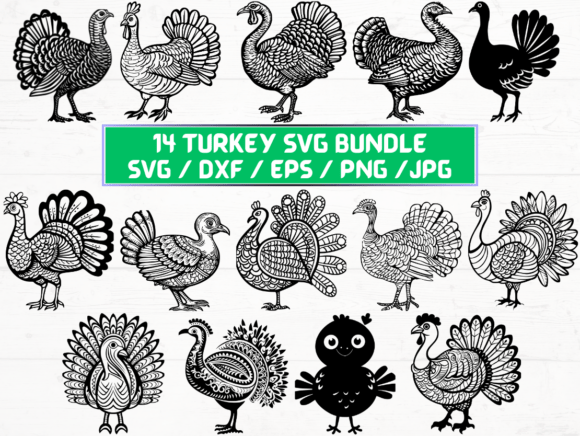
The Turkey SVG File delivers a friendly, slightly rustic illustration—rounded contours, gentle linework, and subtle textural detail that reads as hand-drawn but clean enough for professional use. It doesn’t scream “cartoon” or “clipart.” Instead, it leans into organic warmth: think heirloom grains, kraft paper labels, and hand-stamped thank-you cards. This mood aligns beautifully with food businesses, handmade businesses, boutique stores, and wellness brands seeking approachable authenticity—not corporate polish. It feels like a natural extension of a local business’s voice, not an off-the-shelf distraction.
Where It Elevates Real Small Business Branding
In practice, the Turkey SVG File became a versatile anchor across multiple touchpoints for Hearth & Grain’s campaign:
- Packaging design: Used as a subtle foil stamp on matte kraft bags (SVG + EPS ensured crisp vector output at any scale)
- Product label: Centered on oat milk cartons alongside minimalist typography—enhancing shelf appeal without crowding ingredient lists
- Social media graphics: Layered over warm-toned flat lays in Canva; the 300 dpi PNG files held transparency flawlessly against textured backgrounds
- Printable design: Scaled down for hang tags and scaled up for window decals—thanks to editable SVG and DXF files
- Seasonal campaign visuals: Paired with serif fonts for hero banners and handwritten scripts for Instagram Stories—testing confirmed strong visual hierarchy in both contexts
That versatility directly supports stronger first impressions, clearer product recognition, and more consistent brand identity—especially critical when customers encounter your brand across farmers’ market booths, Instagram feeds, and pantry shelves.
Strategic Uses That Build Trust & Shelf Appeal
This graphic design asset shines where local businesses need emotional resonance and tactile credibility:
- Product mockups: Added instant warmth to digital packaging previews shared with wholesale partners
- Thank-you cards & stickers: Printed on recycled stock—the transparent PNG background eliminated white halos around edges
- Boutique visuals: Embroidered onto linen aprons (via digitized DXF) for staff uniforms—reinforcing brand cohesion
- Hero graphics: Enlarged and faded behind café menu boards for subtle seasonal framing
- Seasonal packaging accents: Repeated as a border motif on gift boxes—SVG scalability kept lines razor-sharp
Each use strengthened customer trust—not by shouting “sale!” but by signaling care in craft, consistency in presentation, and intention behind every visual choice.
Where to Proceed With Intention
Like any design asset, the Turkey SVG File has boundaries. It works less effectively—or requires thoughtful adaptation—in these scenarios:
- Formal corporate branding: Its warmth doesn’t translate to law firms or financial advisors
- Very small labels: Fine interior details (like feather texture) blur below 0.75” height—always test print at actual size
- Crowded packaging layouts: Avoid stacking it beside dense legal disclaimers or multi-lingual ingredient lists
- Luxury minimalist brands: Competes with negative space; better suited to brands embracing texture and narrative
- Low-contrast backgrounds: The medium-weight outline can disappear on beige-on-cream or charcoal-on-black—preview in grayscale
Practical Brand Designer Notes (From Real Workflow)
Before integrating the Turkey SVG File into client work, I always run these checks:
- Test it on real packaging mockups—not just screen previews—to verify proportion and legibility
- Convert to black-and-white to confirm readability in monochrome applications (e.g., embossing, letterpress)
- Preview at 100% scale on small labels (1.5” x 1.5”) to assess fine-line integrity
- Overlay it with your brand’s core palette—does it harmonize or clash with primary/secondary hues?
- Compare side-by-side with top 3 competitor packaging designs—does it stand out *for the right reasons*?
- Check print quality: Open SVG in Illustrator, zoom to 400%, inspect anchor points and path smoothness
- Verify PNG transparency by placing over bold color blocks—no fringing or halo artifacts
- Test font pairings: Does it hold visual weight next to serif (e.g., Playfair), sans serif (e.g., Inter), script (e.g., Pacifico), or display (e.g., Bungee)?
- Confirm commercial license covers physical product sales—especially critical for food labels, stickers, and merchandise
For small business branding, the difference between “just okay” and “memorably ownable” often lives in assets like this one—when chosen with intention, tested rigorously, and applied with respect for context. The Turkey SVG File isn’t a shortcut. It’s a well-crafted tool—one that, in the hands of a thoughtful local business or creative entrepreneur, can deepen connection, elevate perception, and quietly signal: We made this with care.