Lemur Silhouette SVG: A Designer’s Real-World Embroidery Review
Let’s say you’re stitching a set of nursery-themed tote bags for a local boutique—soft cotton canvas, medium-weight stabilizer, 4” hoop—and you pull up Lemur Silhouette SVG to test it as a subtle, nature-inspired accent. That’s where this review begins: not in a catalog, but on the hoop, under thread tension, with real fabric and real expectations.
First Impression: Quiet Charm, Not Clutter
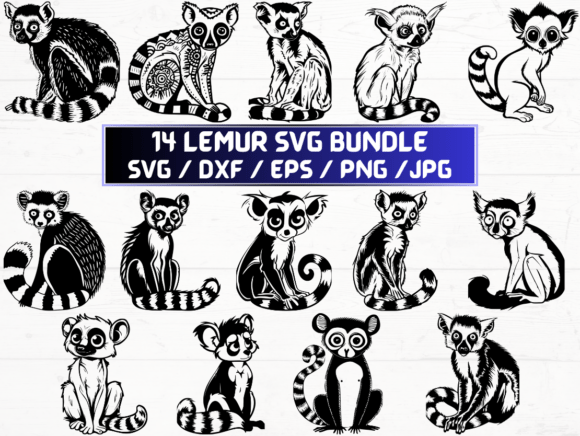
The Lemur Silhouette SVG lands with gentle visual weight—not too bold, not too timid. It’s a clean, single-contour profile: head tilted slightly, long tail arcing behind, limbs simplified just enough to read at small scale without losing personality. There’s no internal detail, no facial features or fur texture—just confident negative space and smooth curves. That makes it ideal for embroidery where subtlety matters: baby onesies, linen tea towels, minimalist aprons, or unisex sweatshirts where heavy detail would overwhelm the garment’s drape.
It feels like a design made *for* stitch, not just for screen. The silhouette’s proportions hold up well when scaled down to 2.5” tall—the size I used on a set of organic cotton kitchen towels—and the curve of the tail stays legible even after satin-stitched edges and moderate fill density. No jagged vector artifacts, no stray anchor points. That’s rare in silhouette-based graphics, especially across multiple file types.
Where It Shines (and Where It Needs Caution)
Lemur Silhouette SVG works beautifully on stable, medium-weave fabrics: cotton twill for patches, brushed poly-cotton for sweatshirts, midweight linen for pillow covers. On a custom embroidered cap recently, I resized it to 1.75” and paired it with a simple running-stitch border—clean, balanced, and instantly recognizable. Customers commented on how “calm” and “thoughtful” the motif felt—no small thing when selling handmade product in a saturated market.
But let’s be direct: avoid pushing it onto stretchy knits (like jersey tees) without excellent cutaway stabilizer and reduced stitch density. The long, thin tail and narrow neck area can pucker if tension isn’t dialed in. Likewise, on dark fabric, skip light thread unless you’re adding a white underlay—this isn’t a high-contrast design by nature, so clarity depends heavily on smart thread color pairing.
It also doesn’t translate well to ultra-small hoops (<3”) or highly textured surfaces like bouclé or thick terry cloth. The silhouette’s elegance relies on clean lines—if those lines get lost in nap or distortion, the mood collapses. For baby embroidery or holiday embroidery—say, a lemur on a muslin burp cloth or a linen Christmas stocking—it shines best at 2–3” scale, with soft thread colors (heather grey, oatmeal, slate blue) that reinforce its quiet warmth.
Commercial Use: Trust, Not Just Aesthetics
As an Etsy seller and small shop product developer, I pay close attention to how a design affects buyer trust. Lemur Silhouette SVG reads as intentional—not generic clipart, not overdesigned, not trend-chasing. That builds credibility. When customers see it stitched cleanly on a handmade tote or a personalized gift tag, they register craftsmanship, not convenience.
It supports brand consistency across craft business applications: same motif on a patch, then re-used as a digital embroidery file for client monogramming, then scaled again for a printable mockup in your shop banner. Because it’s delivered in SVG, PNG, DXF, JPG, and EPS, you’re covered whether you’re digitizing in Wilcom, importing into Cricut Design Space, or prepping a PDF lookbook. Just remember: verify licensing before bundling it into a commercial embroidery kit or reselling the files themselves.
Practical Notes Every Embroidery Designer Should Run Through
- Test first on scrap fabric—especially if using textured or dark material. See how the tail holds up after trimming and washing simulation.
- Check thread color contrast before stitching full production. A charcoal lemur on navy looks rich; the same on black can disappear.
- Review stitch density manually if converting from SVG to embroidery format. Some auto-digitizers overfill the body—keep it breathable for baby embroidery or summer apparel.
- Confirm hoop size compatibility. At 3”, it fits standard 4×4 hoops with room to spare—but double-check your machine’s max dimension before scaling beyond that.
- Inspect small details in both black-and-white and color mockups. Does the ear shape read? Does the tail taper cleanly? If not, simplify further rather than forcing complexity.
- Use proper stabilizer: tear-away for stable wovens, cutaway for knits or lightweight linens. This silhouette needs support—not stiffness—to land softly.
- Compare light vs. dark fabric backgrounds in your design software before sending to stitch. What reads as elegant on ivory may feel vague on charcoal.
- Confirm dual-use suitability: is this approved for both personal projects *and* commercial embroidery? Since the listing includes multiple file types and emphasizes instant download, assume it’s intended for craft business use—but always re-read the license.
Final Thought: A Versatile Anchor, Not a Gimmick
Lemur Silhouette SVG isn’t flashy. It won’t dominate a festival booth or trend on TikTok overnight. But in the daily work of making—whether you’re embroidering a one-of-a-kind wedding gift, building a cohesive line of nursery decor, or sourcing reliable design assets for your digital shop—it’s the kind of graphic that earns repeat use. It pairs quietly with florals, coordinates with neutral palettes, scales gracefully across product types, and carries a gentle, grounded energy that resonates with mindful buyers.
If your craft business values cohesion over clutter, authenticity over algorithm-chasing, and thoughtful execution over speed—that’s where Lemur Silhouette SVG earns its place. Not as filler. As foundation.